Beyond State Rivalry: Building Autonomous Anarchist Cells in a Multipolar World
Horizontal, Encrypted, Federated: The Minimal Tech of Peace Anarchist Cells

Contemporary global politics is increasingly governed by what what Multipolar Red Queen (MRQ) Model describes as a relentless race: in a multipolar environment, no state can afford to slow down for fear of being outpaced by rival powers in exponential domains such as AI, digital finance, and cognitive capital. This self‐reinforcing competition steepens power curves, magnifies even small technological or financial advantages, and concentrates influence in the hands of an ever‐narrowing power elite.
As states invest ever more heavily to ‘run’ merely to maintain their relative positions, traditional Westphalian narratives — where the sovereign state is both the horizon and guarantor of our political existence — become not only inadequate but actively dangerous, perpetuating zero‐sum logic and elite capture. Westphalisan is the logic of nation states with principles like sovereignty, citizenship, borders and the balance of power.
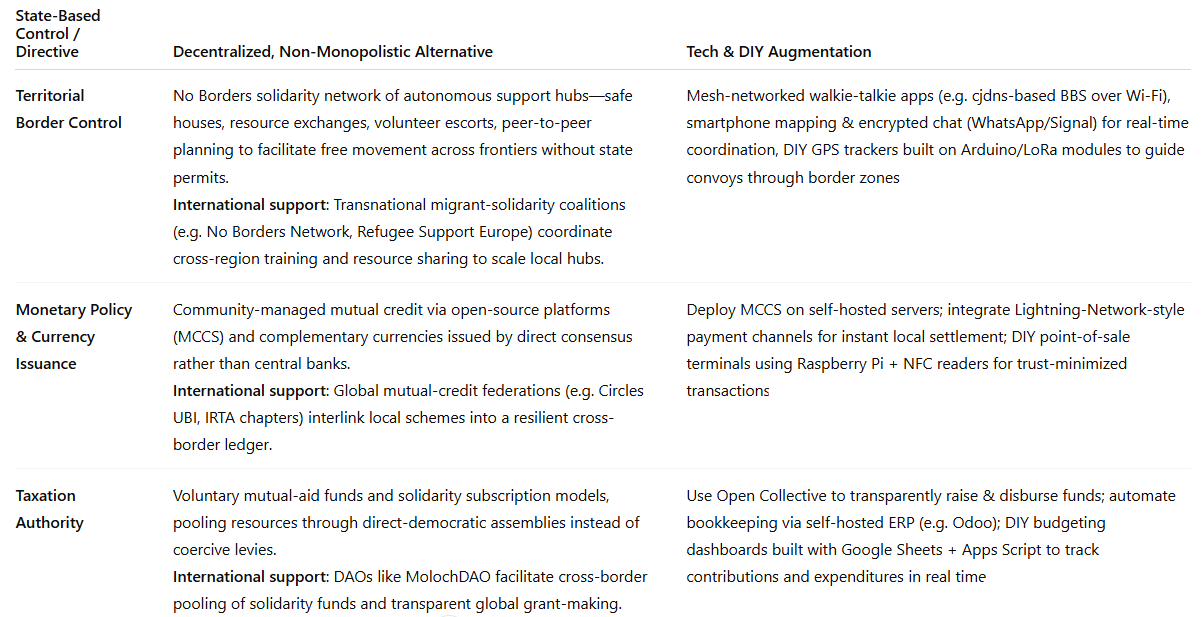
To counter these monopolising Red Queen dynamics and the risks they pose to global stability, we must reconceptualise political life beyond the state as ultimate authority. We argue for a creative turn toward anarchist‐inspired, self‐organised alternatives — solidarity networks that dissolve borders; mutual credit systems that bypass centralised monetary monopolies; federated councils and commons‐based stewardship that replace coercive hierarchies; and peer‐to‐peer digital infrastructuress. By bring forward autonomy, mutual aid, and polycentric governance, such approaches offer more resilient, flexible, just, and adaptive horizons for collective life.
We start with the idea of a minimially viable anarchist cell.
Peace Anarchist Cells
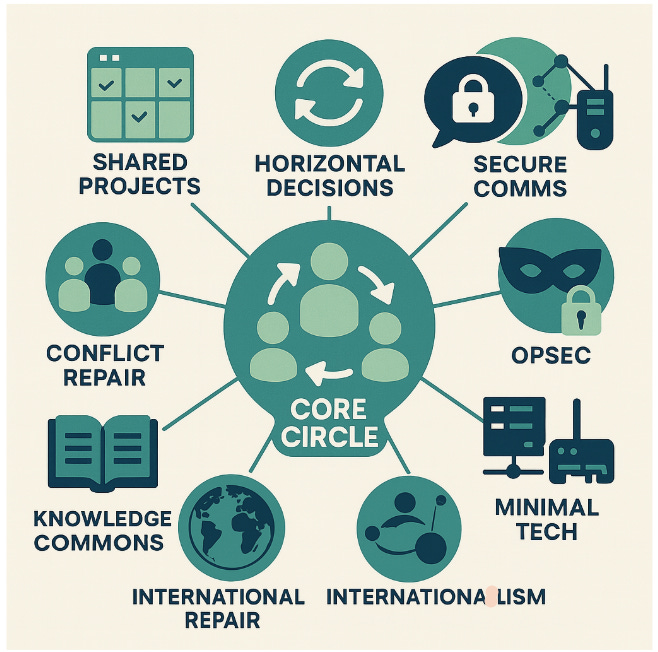
An anarchist cell starts small — just five to ten people who share a commitment to non-hierarchical, peaceful autononmous action. The first step is to form a Core Circle: a group that meets regularly (in person or via a secure chat) and rotates facilitation so that no single person accumulates authority. From early days, you agree on Shared Projects (e.g. implementing a new web-based educational system). Having a concrete, attainable goal keeps everyone aligned and prevents mission creep.
Decisions are made horizontally, using simple consent rounds or a “proposal–objection” cycle - pausing long enough for every voice to be heard before acting. To ensure these conversations aren’t overheard or surveilled, the cell uses Secure, Redundant Communications: an end-to-end encrypted group chat on Signal or a self-hosted Matrix instance as primary, with a small LibreMesh-flashed router or goTenna mesh radios as a fallback when internet access is cut or heavily monitored.
With mission and coordination in place, the cell establishes a Resource Pool & Ledger. Members pledge time, skills, or small cash “solidarity subscriptions” into a mutual-aid fund tracked on a shared spreadsheet or via a lightweight mutual-credit platform like Open Collective or MCCS. This shared pot covers essentials —first-aid supplies, legal support, transport stipends — without relying on banks or taxes. Anyone can see where the money or credits go, reinforcing accountability.
Even the best-intentioned groups run into conflicts, so the cell adopts a Conflict-Resolution Protocol built on restorative justice principles.
To make knowledge portable, the cell maintains a Knowledge Commons — a public GitHub or Etherpad repository containing a one-page “starter playbook,” a roles cheat-sheet (e.g., comms steward, liaison, tech custodian), and outreach templates. When a new member joins, they are given a quick “onboarding packet” so they can hit the ground running, and when another cell wants to replicate your model, they simply fork your repo and adapt.
From week two onward, every cell designates a Liaison — a rotating envoy who exchanges playbooks, encrypted-chat invites, and resource-exchange rules with one or two peer cells. Under the hood, this relies on Interoperable Identity/Trust Systems: shared PGP keys or profiles on a platform like Proof of Humanity so cells can verify each other without centralised IDs.
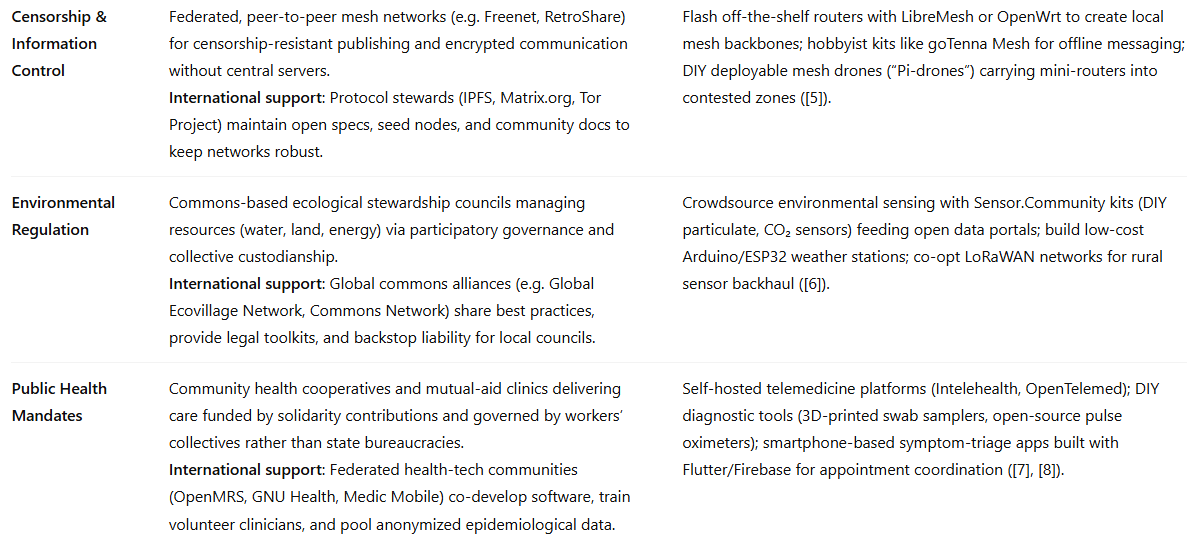
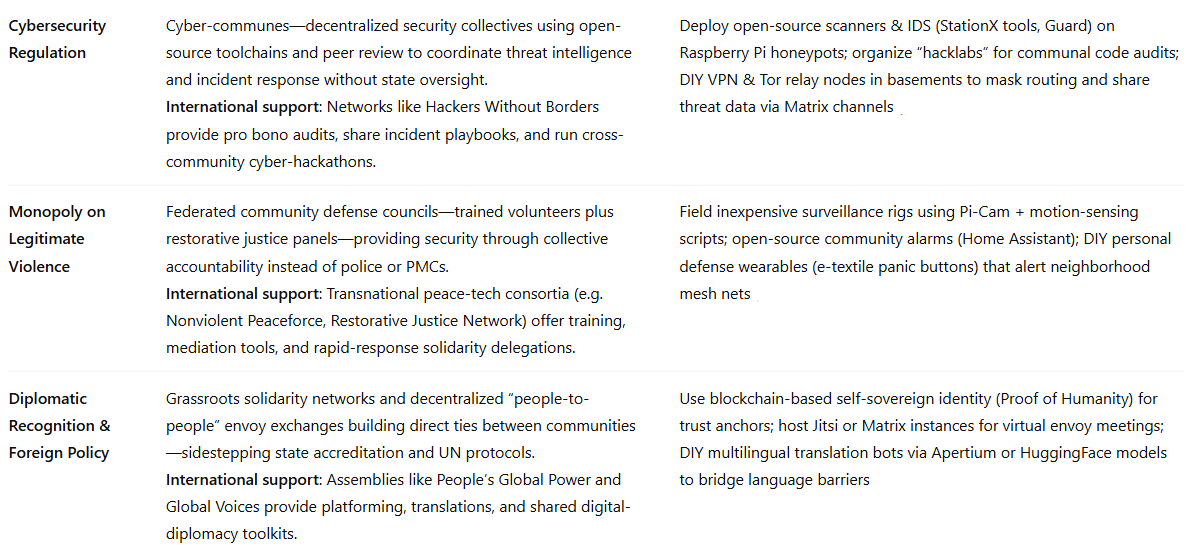
All of this runs on a Minimal Tech Stack that you can assemble in a weekend: a self-hosted Matrix/Element server (or a trusted federation), a single mesh-router (TP-Link flashed with LibreMesh), and a mutual-credit ledger (even a simple spreadsheet will do). Where extra resilience is needed, inexpensive DIY kits — Arduino/LoRa GPS trackers, Raspberry Pi honeypots for cybersecurity monitoring, or 3D-printed swabs for emergency diagnostics — can be plugged in.
Finally every member agrees to Basic OPSEC & Safety measures: using pseudonyms when meeting new contacts, sharing only the minimum personal data needed for coordination, and having a “data-wipe” protocol ready in case devices are seized. These practices protect both individual participants and the broader network from infiltration or state repression.
Commitment to International Repair & Solidarity: Beyond local action, each cell pledges to foster international repair - reducing conflict between communities and nations. Through coordinated outreach — sharing best practices, mutual-aid networks, and conflict-resolution expertise across borders — cells practice solidarity with distant peers facing repression or crisis. This internationalism builds trust and resilience, as cells exchange resources, training, and rapid-response legal-aid coalitions.
By encouraging and supporting the formation of new cells in other regions — through open invitations, shared onboarding packets, and rotating liaison envoys — this network grows organically around the globe. Each new cell not only reinforces local peace-building but also strengthens a web of autonomous nodes committed to repairing harm and preventing violence on an international scale - together building a resilient web of autonomous peace-building nodes beyond the reach of Multipolar Red Queen statism.
Appendix: General Anarchist Strategies
General strategies and supporting technologies are suggested in the table below.